
Tag: chicken poop as fertilizer
The Role of Fertilizer Making Machines in Manure Waste Management
In the quest for sustainable agriculture, managing manure waste effectively has become a pivotal challenge for farmers worldwide. As environmental concerns escalate, the agricultural sector is under pressure to adopt practices that minimize waste and promote the recycling of resources. Enter fertilizer making machines – the unsung heroes turning the problem of manure waste into an opportunity for nutrient recycling. This blog delves into how these machines are revolutionizing manure waste management through the production of organic fertilizer.
The Problem with Manure Waste
Traditional manure management practices often involve storing waste in lagoons or spreading it directly onto fields. While these methods have their place, they come with environmental downsides, including the potential for water pollution, greenhouse gas emissions, and the inefficient use of manure’s nutrient potential. The challenge, therefore, is to find a way to manage manure that is both environmentally friendly and agriculturally beneficial.
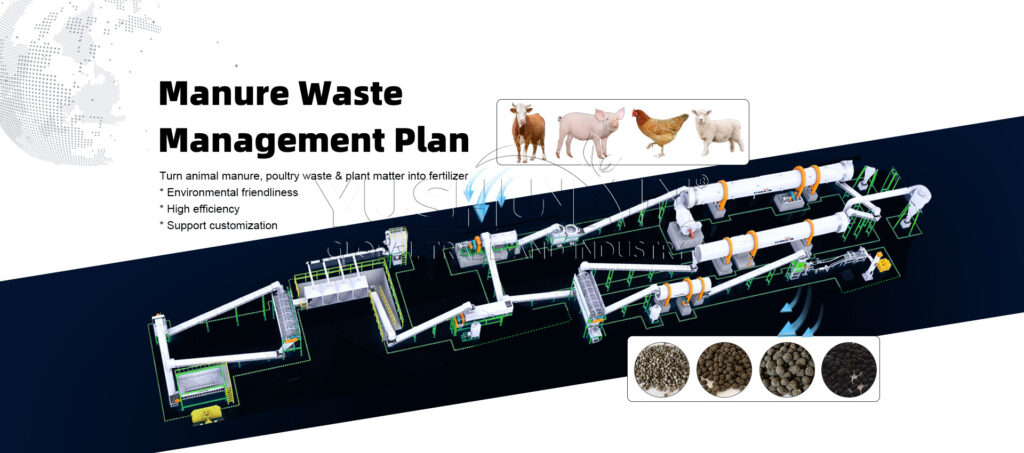
Manure waste to fertilizer machines
The Solution: Fertilizer Making Machines
Manure fertilizer making machines offer a sustainable solution by converting manure into organic fertilizer, a process that adds value to what is otherwise considered waste. These machines come in various forms, including compost turners, granulators, and pellet mills, each playing a unique role in the fertilizer production process.
1. Composting Turners: The foundation of manure-based fertilizer production is efficient composting. Composting turners aerate piles of manure, accelerating the decomposition process (aerobic fermentation). This not only reduces the volume of the waste but also kills pathogens and seeds, resulting in a hygienic, nutrient-rich compost that’s an excellent soil amendment.
2. Granulators and Pellet Mills: Once composted, manure can be further processed into granules or pellets. Granulators and pellet mills compact the composted material, producing uniform particles that are easy to handle, store, and apply. These processes increase the marketability of the final product, as granulated fertilizers are in high demand for their convenience and effectiveness. Click here to learn more
The Environmental and Agricultural Benefits
The transformation of manure into organic fertilizer via these machines offers numerous advantages:
– Reduced Environmental Impact: By preventing runoff and reducing greenhouse gas emissions, fertilizer making machines mitigate the environmental issues associated with raw manure application.
–Enhanced Soil Health: Organic fertilizers improve soil structure, water retention, and microbial activity, leading to healthier crops and reduced reliance on chemical fertilizers.
– Resource Recycling: This approach exemplifies a circular economy, where waste products are repurposed, reducing the need for synthetic fertilizer production and its associated energy consumption.
– Economic Opportunities: Farmers can turn a cost center (manure management) into a revenue stream by selling organic fertilizer, providing an additional income source and contributing to the local economy.
Overcoming Challenges
Despite these benefits, challenges remain. The initial investment in fertilizer making equipment can be significant, and there is a learning curve associated with mastering the composting and granulation processes. However, with increasing technological advancements and financial incentives, these hurdles are becoming more surmountable. You can get more details on https://www.manuremanagementplan.com/manure-waste-management/
Conclusion
Fertilizer making machines are at the forefront of a movement towards more sustainable agriculture. By transforming manure waste into valuable organic fertilizer, they close the loop in nutrient management and contribute to a healthier planet. As technology advances and awareness grows, the adoption of these machines is set to increase, heralding a new era in manure management and environmental stewardship. So, the next time we think about manure, let’s not see it as a waste problem, but as a resource waiting to be unlocked.
What Is the Cost to Build a 20 t/h Chicken Manure Fertilizer Production Line?
January 15, 2026
20 t/h chicken manure fertilizer prouduction line cost
Comments Off on What Is the Cost to Build a 20 t/h Chicken Manure Fertilizer Production Line?
cs
With the rapid growth of intensive poultry farming, chicken manure fertilizer production has become an attractive business opportunity. One of the most searched questions among fertilizer investors is: what is the cost to build a 20 t/h chicken manure fertilizer production line? The answer depends largely on whether you choose a powder fertilizer line or a granular fertilizer production line.
In general, the investment for a 20 tons per hour chicken manure fertilizer plant ranges from USD 100,000 to 150,000 for powder processing, while a granulated fertilizer production line typically costs USD 400,000 to 500,000.
20 t/h Chicken Manure Powder Fertilizer Line Cost
A powdered chicken manure fertilizer production line focuses on dehydration, composting, crushing, and screening. It is suitable for markets that prefer bulk organic fertilizer or as a raw material for further blending.
A typical 20 t/h powder line includes:
Chicken manure dewatering machine or solid-liquid separator
Composting system (windrow compost turner or groove type turner)
Vertical crusher or chain mill
Rotary screener
Automatic or semi-automatic packing machine
The total investment usually falls between USD 100,000 and 150,000, depending on composting method, automation level, and environmental protection requirements. This option offers lower capital cost, shorter construction time, and fast return on investment.
20 t/h Chicken Manure Granular Fertilizer Line Cost
For higher market value and better transportation efficiency, many producers choose a chicken manure granulation production line. Granular fertilizers are easier to store, spread, and export.
A complete 20 t/h chicken manure pellet production line generally includes:
Dewatering and fermentation system
Crushing and batching equipment
Granulation system (disc granulator, drum granulator, or extrusion granulator)
Rotary dryer and cooler
Screening and coating machines
Automatic weighing and bagging system
Because of the additional granulation, drying, and cooling processes, the investment cost is significantly higher. Most 20 t/h chicken manure granular fertilizer plants are built within a budget of USD 400,000 to 500,000.
Key Factors Affecting the Final Investment
Several factors influence the final cost of a chicken manure fertilizer manufacturing plant:
Moisture content of raw chicken manure
Local environmental regulations
Granule size and strength requirements
Degree of automation
Choice of composting and granulation technology
Careful production line design helps avoid unnecessary equipment investment while ensuring stable output. Learn more!
20 t/h chicken manure fertilizer prouduction line cost
Choosing the Right 20 t/h Chicken Manure Fertilizer Solution
Whether selecting a powder fertilizer processing line or a granulated chicken manure fertilizer production system, understanding the cost structure is essential. A properly designed 20 t/h production line can efficiently convert poultry waste into high-value organic fertilizer and support long-term business growth. If you want to convert chicken manure into fertilizer, welcome to visit: https://www.fertilizerequipmentprice.com/20t-per-hour-chicken-manure-fertilizer-production-line/
chicken poop as fertilizer