
Month: August 2026
How Does a Commercial Liquid Organic Fertilizer Manufacturing Process Scale From Mixing to Filling?
A fertilizer producer that moves from trial batches to continuous commercial output needs more than a larger mixing vessel. A reliable commercial liquid organic fertilizer manufacturing process must coordinate raw-liquid preparation, formulation, fermentation, filtration, storage and filling so that every section matches the required hourly capacity. A poor capacity match between these sections can create waiting time, unstable formulations and unnecessary fertilizer production cost even when each individual machine operates normally.
What Raw Materials Fit a Commercial Liquid Organic Fertilizer Production Process?
Your plant should determine the feedstock before it fixes the fertilizer production system design. Different liquid fertilizer raw materials create different requirements for filtration, fermentation, mixing and storage.
Livestock operations may handle liquid fractions from cow manure, pig manure or chicken manure after solid-liquid separation. Biogas projects may use biogas slurry or other nutrient-containing liquid streams. Food-processing operations may work with suitable organic wastewater, while fertilizer manufacturers may formulate products from amino acids, humic substances, soluble nutrient materials, microbial preparations and selected additives.
A commercial liquid organic fertilizer production line design therefore starts with feedstock analysis rather than machine selection alone. Your technical team should evaluate suspended solids, viscosity, nutrient formulation, microbial requirements and the final packaging format.
Water quality also affects liquid fertilizer preparation. A fertilizer plant that produces microbial or water-soluble formulations may require controlled process water. A reverse osmosis treatment stage can support process-water preparation when the incoming water contains excessive dissolved substances. Your plant should match the actual treatment method with the local water analysis instead of adding unnecessary water-treatment machinery.
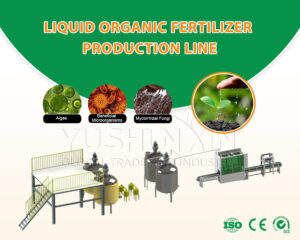
Liquid-Organic-Fertilizer-Production-Line
How Should Mixing and Fermentation Capacity Match the Production Target?
A commercial liquid fertilizer manufacturing process needs balanced batch volume and transfer capacity. A large fermentation tank does not solve a bottleneck when the upstream mixing section or downstream filling section handles much less material per hour.
The formulation section usually controls the addition of organic liquid, nutrient components, microbial agents and functional additives. A mixing or fermentation tank should provide sufficient agitation for the selected formula, while the production procedure should maintain consistent dosing between batches.
The fertilizer manufacturer should also calculate residence time. Fermentation, biological preparation or reaction stages often require much more time than pumping or filling. For this reason, a commercial plant may need several tanks working in sequence instead of one oversized tank. This production design allows one tank to process material while another tank supplies the next section.
A larger plant also needs a clear liquid transfer system. Pumps, pipes and valves must match viscosity and flow requirements. The production manager should treat these parts as one integrated fertilizer manufacturing system because an undersized transfer section can reduce effective plant capacity.
Which Liquid Fertilizer Manufacturing Equipment Controls Product Consistency?
Three equipment groups usually influence the commercial process most directly: the mixing or fermentation tank, the filtration system and the filling machine.
The mixing and fermentation section controls formula uniformity and biological processing. The filtration section removes unsuitable suspended material before the product reaches storage and packaging. A manufacturer that sells liquid fertilizer for irrigation systems or narrow-nozzle applications needs particularly careful filtration management because excessive solids can create downstream handling problems.
A scalable liquid fertilizer manufacturing equipment for scale-up should therefore match filtration throughput with mixing output. The fertilizer production technology should avoid a situation in which the tank releases a full batch faster than the filtration section can handle it.
The filling machine controls the final transition from process liquid to commercial product. Your plant should select filling capacity according to container size, hourly production and labor arrangement. A small operation may use a simpler filling procedure, while a larger factory may integrate filling, capping and labeling into a coordinated packaging system.
How Can a Plant Control Liquid Organic Fertilizer Production Cost?
The lowest machine quotation does not always produce the lowest project investment. A fertilizer producer should calculate the complete production cost from raw-material treatment to finished-product filling.
The budget should include tanks, filtration, transfer piping, pumps, filling equipment, electrical controls, workshop preparation, utilities and installation requirements. The plant should also consider cleaning time, formula-change time and storage requirements because these factors affect real production efficiency.
A modular process can reduce unnecessary initial investment. A new fertilizer factory may start with a suitable mixing and filling capacity and reserve space for additional tanks when sales volume increases. This method gives the project a clearer expansion path than buying oversized fertilizer machinery at the beginning.
A plant that processes both solid and liquid organic streams may also evaluate a complete organic fertilizer production line for the separated solid fraction. This arrangement can help the project plan raw-material handling as a complete fertilizer production solution instead of treating every waste stream independently.
How Does Commercial Liquid Fertilizer Filling Affect the Whole Production Line?
The packaging section determines how quickly finished liquid leaves the storage area. A slow filling stage can force the production team to hold more finished material, which increases storage demand and interrupts continuous fertilizer manufacturing.
A suitable commercial liquid fertilizer filling process should match bottle or container size with the required daily output. The purchasing team should also evaluate filling accuracy, cleaning requirements, material compatibility and future packaging changes before it compares equipment price.
Your project team should calculate the production line from the required finished-product volume backward. This approach helps the team identify the required filling speed, filtration capacity, tank volume and mixing schedule. The resulting fertilizer production procedure usually gives a more practical quotation than a machine-by-machine purchase.
What Should a Buyer Confirm Before Purchasing a Liquid Fertilizer Production System?
A fertilizer producer should confirm raw material, hourly capacity, formulation type, fermentation requirement, process-water condition, finished container size and available workshop space before final equipment selection. These parameters allow the supplier to prepare a realistic fertilizer equipment quotation and a more accurate plant layout.
The buyer should also compare the production system rather than only the individual machine price. A cost-effective fertilizer production project requires balanced processing capacity, reasonable automation and room for future expansion.
Companies that need more information about equipment configuration can learn more from the detailed process page. Near the procurement stage, A professional fertilizer equipment manufacturer – Yushunxin can support the project with equipment configuration and production-line planning based on confirmed material and capacity requirements. You can visit: https://www.fertilizerproductequipment.com/liquid-organic-fertilizer-manufacturing-process/
What Equipment Is Needed for a Complete NPK Fertilizer Production Line?
The NPK fertilizer production line equipment selection is an important step for fertilizer manufacturers, NPK producers, and project investors who plan to establish a commercial fertilizer factory. A complete NPK fertilizer production line requires different machines to complete raw material preparation, mixing, granulation, drying, screening, and packaging procedures.
A suitable fertilizer manufacturing system helps companies produce stable compound fertilizer products while controlling investment costs and improving production efficiency. When buyers plan a fertilizer production project, they need to consider production capacity, raw material characteristics, fertilizer manufacturing process, factory layout, and future expansion requirements.
A professional fertilizer production equipment design should match the actual needs of each fertilizer producer instead of using the same configuration for every project.

NPK Fertilizer Dry Granulation Technique
What Machines Are Included in an NPK Fertilizer Production Line?
A complete NPK fertilizer production line usually includes several types of fertilizer machinery that work together as one production system.
The raw material preparation stage is the beginning of fertilizer manufacturing. Crushing machines help reduce raw material particle size and improve material uniformity before mixing. Screening equipment can remove unsuitable particles and support stable fertilizer production.
The mixing process is another important part of NPK fertilizer manufacturing. A fertilizer mixer combines different raw materials according to the required nutrient formula. Uniform mixing improves the consistency of final fertilizer granules.
The granulation stage determines the final fertilizer product shape. Different fertilizer manufacturers may select suitable granulators according to raw material conditions and market requirements. Disc granulators, rotary drum granulators, and extrusion granulators are common options in fertilizer production systems.
The drying, cooling, screening, and packaging stages complete the NPK fertilizer production procedure and prepare finished products for storage and transportation.
How Does NPK Fertilizer Production Equipment Work Together?
The performance of a fertilizer production line depends on the cooperation between different machines.
First, fertilizer raw materials enter the preparation system. Common NPK fertilizer materials include urea, ammonium phosphate, potassium chloride, potassium sulfate, and other nutrient materials.
Next, the batching and mixing system controls the proportion of different ingredients. Accurate material preparation helps fertilizer manufacturers maintain product quality.
After mixing, the material enters the granulation system. The fertilizer granulator changes powder materials into commercial fertilizer particles. The granulation technology selection depends on fertilizer formulas, production capacity, and required granule characteristics.
After granulation, drying and cooling equipment control moisture content. Screening machines separate qualified fertilizer granules from oversized or undersized materials. Finally, packaging equipment completes the fertilizer manufacturing process.
This complete fertilizer production system allows manufacturers to handle raw materials efficiently and produce fertilizer products suitable for different markets.
What Raw Materials Can Be Used in an NPK Fertilizer Manufacturing Plant?
The raw materials used in NPK fertilizer production influence equipment selection and production design.
Common raw materials include:
- Urea
- Ammonium sulfate
- Monoammonium phosphate (MAP)
- Diammonium phosphate (DAP)
- Potassium chloride
- Potassium sulfate
Different fertilizer producers may adjust formulas according to local agricultural demand and market requirements.
For example, compound fertilizer manufacturers usually combine nitrogen, phosphorus, and potassium materials to create balanced NPK fertilizer products. The fertilizer production equipment needs to handle different powder characteristics and maintain stable production performance.
A suitable fertilizer manufacturing process considers raw material properties before selecting machines. This approach helps reduce production problems and improves the efficiency of fertilizer production machinery.
How Much Does Complete NPK Fertilizer Production Equipment Cost?
The fertilizer production line cost depends on many factors, including production capacity, machine configuration, automation requirements, and factory conditions.
A fertilizer equipment quotation usually considers:
- Production capacity requirements
- Raw material characteristics
- Required fertilizer granule size
- Level of automation
- Supporting equipment selection
- Installation conditions
Small fertilizer manufacturers may choose a compact fertilizer production system with essential machines. Large NPK fertilizer producers may require a complete automatic fertilizer manufacturing plant with higher output capacity.
The fertilizer plant investment should include equipment purchase, operation costs, maintenance requirements, and future expansion planning.
A reasonable fertilizer production line design helps investors balance equipment price and long-term production benefits.
How Can Buyers Select Suitable Fertilizer Manufacturing Equipment?
Selecting fertilizer machinery requires more than comparing the lowest price. A suitable fertilizer production solution should consider the complete manufacturing process.
Buyers should evaluate:
- Whether the fertilizer machine matches the target capacity
- Whether the equipment can handle selected raw materials
- Whether the fertilizer production process meets product requirements
- Whether the supplier provides technical support
Conclusion
A complete NPK fertilizer production line requires different fertilizer production machines working together, including crushing equipment, mixing machinery, granulation equipment, drying systems, screening machines, and packaging solutions.
For fertilizer manufacturers, NPK producers, and project investors, the correct fertilizer production equipment selection helps create a practical fertilizer manufacturing system with controlled investment and reliable operation.
A professional fertilizer equipment manufacturer – Yushunxin provides customized fertilizer production solutions according to different production requirements.
For detailed information about NPK fertilizer production line equipment, please visit:
https://www.fertilizerproductequipment.com/npk-fertilizer-production-line/
Как подобрать производительность линии по суточному объёму куриного помёта
Для птицефабрики производительность нельзя выбирать только по максимальному числу тонн в час в каталоге. Сначала нужно зафиксировать фактическую массу свежего помёта за сутки, его влажность, сезонный максимум и реальное число часов работы участка. линия органических удобрений из куриного помёта с расчётом по суточному потоку должна быть подобрана так, чтобы приёмка, ферментация и последующая переработка работали как единая система, а не как набор отдельных машин.
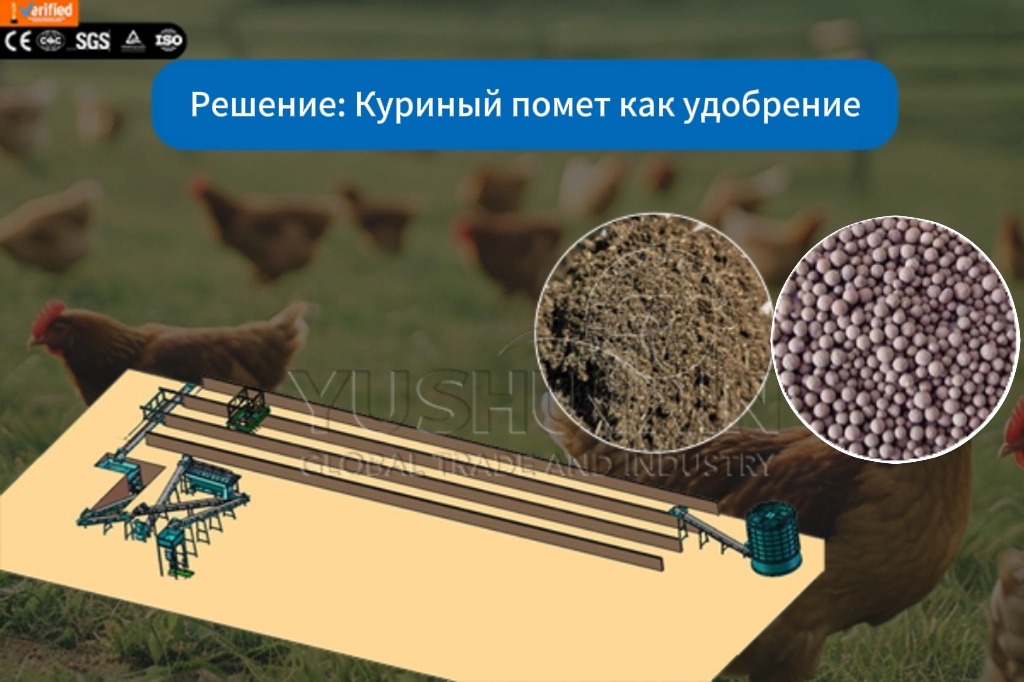
Решение-Куриный-помет-как-удобрение
Начинайте с входного потока, а не с паспортной производительности готового продукта
Суточный объём свежего помёта — это исходная величина, но не готовая производительность товарного удобрения. Например, если хозяйство получает 24 т сырья в сутки, а участок постобработки работает 8 часов, базовая подача составляет 3 т/ч. Это только стартовая оценка: масса материала меняется после добавления структурирующих компонентов, ферментации, снижения влажности, просеивания и возврата нестандартной фракции. Поэтому в техническом задании лучше отдельно указывать входной поток сырья и требуемый выпуск порошкового или гранулированного продукта.
Отдельно рассчитайте участок ферментации
Ферментация не должна рассчитываться по той же логике, что дробилка или гранулятор. Здесь важны объём материала в обработке, способ размещения, режим ворошения, доступная площадь и фактическая продолжительность процесса. Для общего понимания терминов можно использовать справочную статью о компостировании. Если применяется буртовая технология, самоходный компостер для участка ферментации может быть включён в проект для перемешивания материала и улучшения доступа воздуха. Конкретный тип ворошителя выбирают по ширине площадки, объёму сырья и принятой схеме ферментации.
Определите, что вы будете продавать: порошок или гранулы
После ферментации состав оборудования меняется. Для порошкового продукта обычно нужны операции дробления, смешивания при необходимости, просеивания и упаковки. Для гранулированного продукта дополнительно требуются гранулирование, а в зависимости от влажности и выбранной технологии — сушка, охлаждение и более точная классификация по размеру. Поэтому оборудование для переработки свежего куриного помёта под заданную часовую нагрузку следует подбирать уже после выбора товарной формы.
Проверьте баланс производительности между участками
Ошибка при покупке линии часто возникает не из-за слишком маленького гранулятора, а из-за несогласованности соседних узлов. Дробилка, смеситель, гранулятор, сушилка, охладитель, грохот и упаковка должны соответствовать одному расчётному потоку. При этом резерв производительности нужен там, где возможны колебания влажности, плотности сырья или доли возврата. Просто выбирать максимальный запас для каждой машины невыгодно: это увеличивает стоимость оборудования и энергопотребление без гарантии роста фактического выпуска.
Какие данные подготовить поставщику
Перед запросом коммерческого предложения полезно передать: объём свежего куриного помёта в сутки; среднюю и максимальную влажность; наличие подстилки и примесей; желаемую форму продукта; требуемую часовую или годовую производительность; число рабочих часов и смен; доступную площадь; условия по электричеству и тепловому источнику; формат упаковки. Чем точнее эти данные, тем легче сопоставить мощность отдельных машин и избежать узких мест.
Если вы планируете новую птицеферму, расширяете действующий участок или хотите перейти от сырого помёта к товарному удобрению, можно посмотреть подходящую конфигурацию и затем запросить подбор по фактическому суточному объёму. Окончательная комплектация должна определяться после подтверждения сырья, влажности, режима работы и требований к готовому продукту.
Подробная страница решения: https://www.sxmashina.com/liniya-po-proizvodstvu-organicheskikh-udobreniy-iz-kurinogo-pometa/
How to Design a Commercial Freeze-Dried Fruit Processing Line ?
A commercial freeze-dried fruit processing line needs more than one freeze dryer. You need each processing stage to connect smoothly from fresh fruit to final packaging. A practical line normally includes washing, cutting, surface drying, quick freezing, freeze drying, conveying, and packaging equipment.
The right configuration also depends on your fruit type, required production capacity, and available factory space. A complete commercial freeze-dried fruit processing line can help you process mangoes, strawberries, bananas, pineapples, apples, peaches, blueberries, durians, and other fruits.
1. Start With Fruit Cleaning and Sorting
Fruit quality affects every later processing stage. Therefore, the production line should start with sorting and cleaning.
Operators first remove damaged or unsuitable fruit. The washing section then removes soil, dust, and surface impurities. Different fruits need different cleaning methods because soft berries require gentler handling than firm fruits.
For many fruit projects, a Bubble Cleaning Machine provides a practical washing solution. You can also add a manual sorting platform before or after washing when your process requires more manual inspection.
Good preparation helps the next machines receive cleaner and more consistent raw materials.
2. Prepare Fruit With Suitable Cutting Equipment
After washing, operators peel, core, slice, dice, or divide the fruit according to the final product.
Mango may need peeling and slicing. Pineapple may need peeling, coring, and cutting. Strawberries or berries often require less cutting and gentler handling.
Uniform pieces also help the freezing and drying stages handle the product more consistently. Therefore, the cutting section should match your fruit type and final product shape.
You can also connect different machines with Food Conveyors. Conveyors can reduce unnecessary manual transfer and create a smoother production flow between preparation stages.
3. Remove Surface Water Before Freezing
Fruit often carries surface water after washing. Excess surface water can make the next processing stage less convenient.
An Air Dryer for Freeze-Dried Food can remove surface moisture before the fruit enters the freezing section. The air drying stage connects the cutting process with quick freezing and helps remove surface moisture from the prepared fruit.
This stage also helps you create a more organized transition from wet processing to the freezing area.
4. Add a Quick Freezing Section
Quick freezing prepares the fruit for vacuum freeze drying. The production line can use a freezing tunnel, liquid nitrogen freezer, or spiral freezer according to the required workflow.
An Industrial Tunnel Freezer suits factories that want continuous material movement through the freezing stage. After freezing, operators can load the frozen fruit onto trays and transfer it into the freeze dryer.
The freezing section should also connect smoothly with the upstream preparation machines. This arrangement reduces unnecessary handling and keeps production organized.
5. Match the Freeze Dryer With Your Capacity
The freeze dryer forms the core section of the line. Inside the machine, the vacuum system lowers chamber pressure while the shelf heating system supplies controlled energy. Frozen water changes directly into vapor, while the condenser captures the released moisture.
Your production target determines the suitable machine size. HADOF lists 30kg, 50kg, 100kg, and 200kg batch options across its fruit freeze-drying equipment range.
Instead of selecting equipment only by machine size, you can build the freeze-dried fruit production line around your actual raw material, production capacity, and factory area.
HADOF can configure the processing equipment and line layout according to these project conditions.
6. Complete the Line With Packaging Equipment
Freeze-dried fruit needs suitable packaging after drying. Operators should move the finished fruit into the packaging stage without unnecessary exposure to the surrounding environment.
A Food Packing Machine can complete the final packaging section and connect with weighing or conveying equipment when required. The production line page recommends moisture-resistant packaging for finished freeze-dried products.
A complete line can therefore follow this process:
Sorting → Washing → Cutting → Surface Drying → Quick Freezing → Freeze Drying → Packaging
This structure gives each machine a clear role and creates a logical material flow through the factory.
7. Plan the Factory Layout Around Material Flow
Factory layout matters when you connect several machines into one commercial line.
The wet processing area can include washing, peeling, cutting, and surface drying. The later area can include quick freezing, freeze drying, weighing, and packaging. You should also leave practical space for trays, carts, operators, equipment access, raw materials, and finished products.
A straight-line arrangement can suit some compact factories. A wider workshop may support another layout that shortens material transfer. However, you do not need to determine every detail before requesting a solution.
HADOF can design a customized production line according to your raw material, required output, and available factory space.
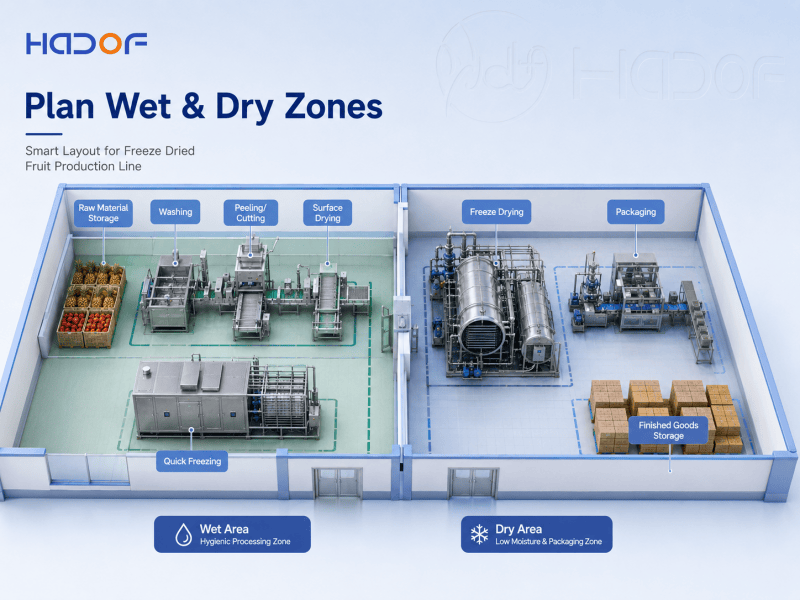
Factory Layout
Build a Commercial Fruit Freeze-Drying Line
A successful fruit freeze-drying project connects pretreatment, freezing, freeze drying, conveying, and packaging into one practical workflow. Matching these stages helps your factory handle different fruit products while keeping the production process organized.
HADOF can configure a suitable solution according to your fruit material, production capacity, and factory space. If you need a customized freeze-drying production line, please visit the HADOF Freeze Dryer homepage:https://www.freezehadof.com/
Which Breading System Keeps Croquettes and Fish Cakes Intact During High-Volume Coating?
High-volume formed-food factories need a coating system that protects product shape while it applies batter and crumbs consistently. An industrial croquette and fish cake breading system with gentle conveying should control product temperature, spacing, belt movement, batter pickup, crumb circulation, and transfer height before frying. Potato croquettes, meat croquettes, seafood croquettes, fish cakes, fish patties, vegetable cakes, and filled snacks can crack, flatten, overlap, or lose edges when the production process applies too much pressure or creates abrupt transfers. Therefore, the equipment buyer should evaluate the entire food coating procedure rather than compare one breading machine price.
Why Do Croquettes and Fish Cakes Break During Automatic Coating?
The raw material formula controls product strength before any machine touches it. Warm potato mixtures can deform, soft fish paste can stick, large inclusions can weaken edges, and inconsistent unit weight can change conveyor behavior. The forming process also affects density, thickness, and surface smoothness. A factory should control mixing, portioning, forming, chilling, and holding time before products enter predusting or battering equipment. The production manager should also prevent piles at the infeed because overlapping pieces receive uneven coating and create collisions. This food preparation management gives every croquette or fish cake enough structural strength for conveying while preserving the texture that the recipe requires.
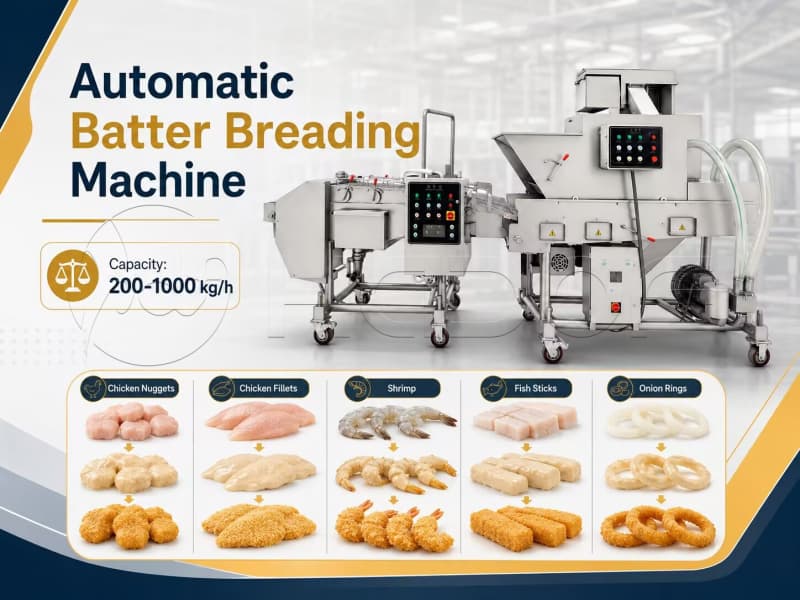
Automatic Batter Breading Machine
Which Breading Machine Features Support Gentle Product Handling?
A single-layer wire belt can carry formed foods without rolling or stacking when operators maintain suitable spacing. The lower crumb bed can support each product bottom, while an upper crumb curtain can cover the top and sides. A crumb elevator can recirculate surplus material, and a vibrator or air knife can remove loose particles before the next transfer. The press roller needs careful height and pressure settings because excessive force can flatten soft croquettes or damage fish cake edges. Buyers who compare an automatic crumb coating machine for fragile formed foods should review belt width, belt speed, transfer gaps, roller adjustment, crumb depth, air volume, and cleaning access. These controls help the food production system manage coating pickup without using one aggressive setting for every product.
How Should Predust, Batter, and Crumbs Match the Product Formula?
The coating sequence should match surface moisture and the required finished shell. A light predust can manage moisture and give the wet layer a more consistent contact surface. A waterfall batterer can suit thin, free-flowing slurry, while a submerging batterer can guide products through deeper or thicker batter when the upper belt keeps lightweight pieces under the surface. Fine crumbs can cover small surface details, while coarse crumbs can create a more open texture. The factory team should test flour, starch, water, egg ingredients, seasonings, and crumb size with the actual croquette or fish cake. The croquette format and its common fillings also show why one food manufacturing technique cannot suit every potato, meat, fish, cheese, or vegetable recipe.
How Can Conveyors Prevent Cracks, Overlaps, and Coating Loss?
The line designer should align infeed height, batterer discharge, breader entry, fryer feed, and belt speeds. Short, level transfers reduce drop impact, while synchronized conveyors reduce product compression and gaps. The feeding system should create one layer with consistent spacing before the battering process. Operators should also match conveyor speed with coating residence time because excessive speed can reduce coverage and unstable flow can create product contact. A wider belt can raise throughput only when upstream forming, batter supply, crumb recovery, and downstream frying can support the same load. This food handling design protects product shape and keeps the industrial coating process stable during long production runs.
Why Must the Breading Line Match the Continuous Fryer?
The wet coating remains vulnerable until the frying process sets the outer layer. The transfer into hot oil should avoid long drops, sharp direction changes, and crowded product entry. The continuous fryer configuration for breaded formed products can connect coating, controlled immersion, oil filtration, deoiling, cooling, freezing, and packaging equipment. The fryer belt width and speed should match the breader output, while the oil management system should handle loose crumbs from the coating line. Operators should control product spacing, frying temperature, residence time, and oil residue removal according to product thickness and formula. This coordinated food treatment system reduces the risk that a good coating process loses quality during the next transfer.
What Capacity and Quotation Details Should Procurement Teams Compare?
The target equipment page lists battering and breading options across different belt widths and production capacities, so the procurement team should compare equal configurations. The buyer should provide product dimensions, unit weight, product temperature, hourly output, batter viscosity, crumb type, coating pickup target, voltage, workshop dimensions, and preferred automation. The quotation should identify the batter mixer, preduster, batterer, breader, crumb recovery, conveyors, fryer connection, controls, spare parts, and excluded equipment. Fried food solutions engineering for coating and frying lines gives project buyers a reference for connecting separate machinery into a complete food manufacturing system. This scope comparison helps investors distinguish essential equipment from optional expansion and keeps the purchase decision within the approved budget.
The most suitable system keeps the product cold and consistent, feeds one layer, matches the coating recipe with the product surface, limits pressure, synchronizes every conveyor, and connects smoothly with the fryer. Croquette and fish cake manufacturers should evaluate raw material preparation, forming, battering, breading, frying, cooling, and freezing as one production process. This total-to-detail review supports a cost-effective equipment investment and reduces avoidable product damage during high-volume food processing. Customers can review the target equipment at https://www.friedfoodsolutions.com/automatic-batter-breading-machine/
Роликовый или барабанный гранулятор: какая технология выгоднее для вашего сырья
Выбор гранулятора начинается не с цены отдельной машины, а с анализа сырья и требований к готовому продукту. Если предприятие перерабатывает сухие порошковые компоненты и стремится сократить тепловые операции, линия роликового гранулирования для сухого порошкового сырья может стать рациональной основой проекта. Для влажных смесей, больших стабильных потоков и получения округлых гранул чаще рассматривают барабанную технологию.
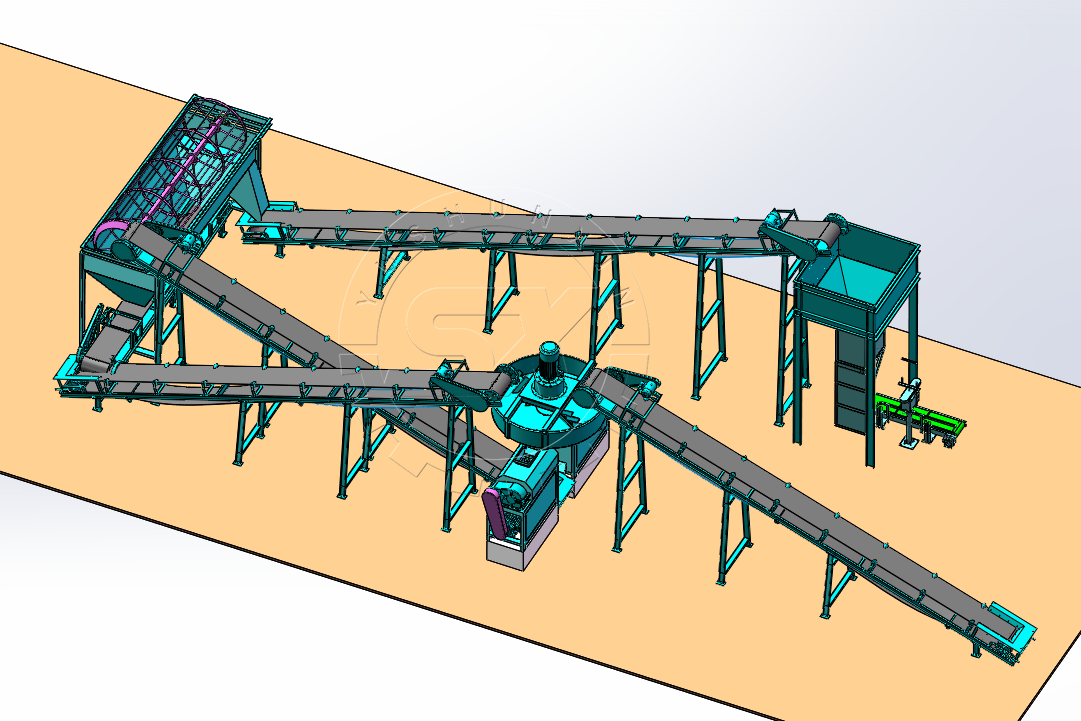
Экструзионная-линия-грануляции-2т-ч
Когда выгодна роликовая экструзия
Двухвалковый гранулятор уплотняет подготовленный порошок механическим давлением. Сырьё проходит дозирование, дробление, смешивание, прессование, разделение сформованного материала, просеивание и упаковку. При подходящих свойствах смеси процесс не требует отдельной стадии сушки и охлаждения. Это уменьшает число тепловых агрегатов, площадь участка и потребность в топливе.
Такая схема особенно интересна производителям NPK, сульфата аммония и других сухих минеральных смесей. Однако низкая исходная влажность сама по себе не гарантирует устойчивого результата. Нужно проверить гранулометрический состав порошка, насыпную плотность, способность смеси к уплотнению, требуемую прочность гранул и износ формующих деталей. Перед закупкой рекомендуется испытать реальное сырьё и зафиксировать режимы, при которых получается товарная фракция.
Для проекта, где важны компактность и сокращённая технологическая цепочка, двухвалковая экструзионная линия без стадии сушки должна рассчитываться как единая система. Производительность питателей, смесителя, гранулятора, грохота и возвратного контура необходимо согласовать между собой.
Когда лучше барабанная технология
Барабанный гранулятор формирует частицы при вращении материала и контролируемом добавлении жидкости или связующего. Технология подходит для смесей, которым требуется агломерация во влажной среде, и обычно легче масштабируется для непрерывного крупнотоннажного выпуска. При сравнении можно изучить характеристики барабанного гранулятора для влажной грануляции.
Барабанная линия обычно включает дозирование, измельчение, смешивание, грануляцию, сушку, охлаждение, просеивание, возврат некондиционной фракции, нанесение покрытия и упаковку. Поэтому первоначальная комплектация и расход энергии могут быть выше. Зато оператор получает больше возможностей для регулирования роста округлых гранул при работе с рецептурами, которые требуют влаги, пара или связующего.
Различия между типами машин удобно сопоставлять через классификацию промышленных грануляторов, но окончательное решение всегда зависит от конкретного материала.
Какие данные нужны для выбора
Поставщику следует передать состав сырья, влажность, размер частиц, часовую и годовую мощность, требуемый диаметр и прочность гранул, число рабочих часов, доступные энергоресурсы, площадь цеха и формат фасовки. Затем сравнивают не только стоимость гранулятора, но и полный бюджет линии, энергопотребление, возврат материала, расход быстроизнашиваемых деталей и требования к персоналу.
Если сухой порошок хорошо прессуется, роликовая схема способна уменьшить число операций. Если продукт должен формироваться во влажной среде и предприятие планирует большой непрерывный поток, барабанная линия часто оказывается более подходящей. Получить подробную конфигурацию этого решения стоит после лабораторной или производственной проверки сырья.
Для получения более подробной информации, пожалуйста, посетите: https://www.sxmashina.com/rolikovaya-ekstruzionnaya-liniya-granulyatsii/
Как выбрать гранулятор куриного помёта для фермы или завода органических удобрений
August 28, 2026
Куриный помёт
Comments Off on Как выбрать гранулятор куриного помёта для фермы или завода органических удобрений
cs
Ферма или завод получает качественные гранулы только после правильной подготовки куриного помёта и выбора подходящего принципа формования. Поэтому гранулятор куриного помёта для фермы и завода удобрений следует подбирать по степени ферментации, влажности, размеру частиц, требуемой производительности и форме готового продукта. Такой подход связывает fertilizer production process с реальным состоянием органического сырья и помогает избежать покупки машины, которая не соответствует потоку конкретной птицефабрики.
20 t/h chicken manure fertilizer prouduction line cost
Почему свежий куриный помёт нельзя оценивать так же, как готовый компост перед грануляцией?
Свежий помёт содержит нестабильную влагу и может иметь неоднородную структуру. Гранулятор должен получать подготовленный материал, потому что сырой поток создаёт проблемы с налипанием, дозированием и формированием прочных частиц. Целевая страница Shunxin прямо связывает грануляцию с ферментированным и разложившимся куриным помётом.
Ферма поэтому рассматривает компостирование как подготовительный этап fertilizer processing system. После стабилизации материала дробилка может уменьшать крупные комки, а смеситель может выравнивать состав перед грануляцией. Эти два узла особенно важны, если хозяйство смешивает помёт с наполнителем или другими органическими компонентами.
Справочная статья про компост как подготовленное органическое сырьё помогает понять общий принцип аэробного разложения органической массы. Для промышленного проекта технолог затем переводит этот принцип в требования к влажности и степени подготовки сырья перед fertilizer granulation equipment.
Как влажность и размер частиц влияют на выбор гранулятора куриного помёта?
Гранулятор с мокрым перемешиванием использует механическое воздействие зубьев и контролируемую влажность для быстрого образования гранул. Страница оборудования для органических удобрений того же производителя указывает для соответствующей серии производительность 1–8 т/ч и влажность подаваемого материала 20–40%. Эти параметры дают ориентир для понимания технологии, но реальный проект должен учитывать конкретный компост и требуемую фракцию.
Гранулятор органических удобрений с мокрым перемешиванием подходит для тонкодисперсных органических материалов и показывает, почему предварительное измельчение влияет на сферичность и однородность. Ферма с крупными волокнистыми включениями должна уделить больше внимания подготовке сырья, чем хозяйство с однородным зрелым компостом.
Если материал поступает с нестабильной влажностью, оператор получает колебания размера и плотности гранул. Поэтому fertilizer handling process должен поддерживать одинаковую подачу и не допускать резких изменений состава между партиями.
Какая производительность гранулятора подходит небольшой ферме и промышленному заводу?
Целевая страница указывает диапазон производительности 1–8 т/ч для гранулятора куриного помёта. Покупатель не должен автоматически выбирать максимальную модель. Ферма сначала рассчитывает количество подготовленного компоста, которое реально поступает на грануляцию за рабочую смену.
Если птицефабрика производит меньше сырья, слишком крупная машина увеличивает fertilizer plant investment и установленную мощность без соответствующей загрузки. Если завод планирует принимать сырьё от нескольких хозяйств, малый гранулятор может стать узким местом. Инженер также учитывает резерв на обслуживание и сезонные колебания потока.
Оборудование для гранулирования ферментированного куриного помёта должно соответствовать именно массе подготовленного материала, а не массе свежего помёта до компостирования. Это различие помогает точнее рассчитать fertilizer production line и избежать завышенного тоннажа в техническом задании.
Как требования к гранулам влияют на конструкцию и настройки оборудования?
Покупатель определяет требуемый размер частиц, плотность, прочность и допустимую долю мелочи. Завод, который продаёт гранулы в мешках, обычно уделяет больше внимания однородности товарной фракции и устойчивости при транспортировке. Ферма, которая использует продукт внутри хозяйства, может допускать более широкий диапазон размера.
Технолог контролирует скорость подачи, степень измельчения исходного материала и влажность. Гранулятор должен получать равномерный поток, иначе fertilizer manufacturing system начинает работать циклично: одна партия формируется нормально, а следующая создаёт возврат или избыток мелочи.
Yushunxin предлагает разные процессы грануляции куриного помёта, включая мокрое перемешивание, барабанный, дисковый и сухой экструзионный подходы. Поэтому покупатель получает пользу от сравнения технологий по фактическим свойствам компоста, а не по внешнему виду машины.
Как сравнить цену гранулятора и полную стоимость проекта переработки помёта?
Цена основного агрегата составляет только часть fertilizer machinery cost. Инвестор также учитывает подготовку сырья, электрическую мощность, фундамент, транспорт между участками и обслуживание. Если компост требует дробления и смешивания, эти операции должны входить в бюджет с самого начала.
Заказчик получает более точное предложение, когда поставщик знает суточный объём помёта, выход подготовленного компоста, влажность, требуемую фракцию и график работы. Покупатель может посмотреть конфигурации для вашего производства и затем сравнить несколько моделей по реальной загрузке.
Подходящий гранулятор должен работать в согласовании с ферментацией и подготовкой материала. Такой выбор помогает ферме или заводу превратить зрелый компост в стабильный товарный продукт без ненужного запаса мощности и лишних стадий. Целевая страница: https://www.granulyator.com/product/granulyator-kurinogo-pometa/
гранулятор куриного помётагрануляция помётаоборудование для гранулорганические удобренияпереработка помётаферма птицы