
Category: Chicken manure fertilizer pellets production line
How to Upgrade an Existing Chicken Manure Compost Plant into a Granulation Line
If your plant already produces stable, mature chicken manure compost, the next step is often to convert it into uniform fertilizer granules. Granular fertilizer is easier to store, transport, package, and sell than loose compost powder. For many poultry farms and organic fertilizer producers, the most practical strategy is to upgrade chicken manure compost into granules instead of rebuilding the entire plant.
Check the Condition of Your Finished Compost
Before adding granulation equipment, check the moisture, particle size, maturity, and impurity level of your compost. Well-fermented chicken manure should have stable moisture, no strong ammonia odor, and few undecomposed materials.
If the compost contains large lumps, long fibers, stones, or excessive moisture, granulation may become unstable. A crusher and screening machine are usually installed before the granulator to create a uniform feed material. You may also need a mixer if you plan to adjust the formula or add humic acid, microbial agents, or other nutrients.
Choose a Suitable Granulation Process
A composted chicken manure granulation line for existing compost plant should match the condition of your raw material and the required granule shape.
A disc granulator is suitable for producing round particles with flexible capacity. A new-type organic fertilizer granulator performs well with fibrous compost and can provide a stable granulation rate. A rotary drum granulator is generally more suitable for large-scale, continuous production.
Your final choice should consider compost moisture, target particle size, workshop space, automation requirements, and whether the granules need drying. Get customized solution.
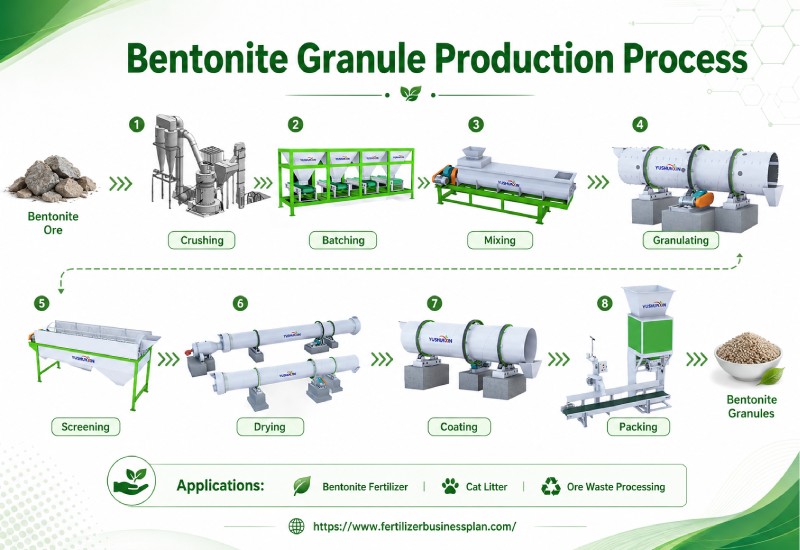
bentonite granule production process
Add the Required Downstream Equipment
Granulation is only one section of the upgrade. After forming, the granules may require drying, cooling, screening, coating, and packing. When your finished compost already has low moisture and granulation requires little added water, you may be able to simplify the drying system.
A typical upgrade may include a crusher, screener, mixer, granulator, dryer, cooler, final screening machine, coating machine, and automatic packing system.
For medium-scale commercial production, a 5–10 t/h chicken manure granulation line can provide continuous output while remaining practical for many existing fertilizer plants.
Calculate the Total Investment
The cost to turn chicken manure compost into pellets depends on production capacity, granulator type, moisture control, workshop layout, automation level, dust collection, and packaging requirements.
A compact system without a dryer usually requires less investment. A complete line with drying, cooling, coating, and automatic packing costs more but produces finished granules with better storage and commercial qualities.
Your budget should also cover electrical systems, installation, civil works, conveyors, spare parts, and commissioning.
Connect the New Line with Your Existing Plant
To upgrade compost fertilizer production line successfully, the new machines must connect smoothly with your existing compost storage, feeding, and finished-product sections.
Before confirming the design, provide your workshop dimensions, available power supply, compost moisture, expected hourly capacity, target granule size, and packing specifications. A properly designed upgrade can help you produce stronger, cleaner, and more marketable chicken manure fertilizer granules without replacing your current composting system. If you are interested in the project, you can visit https://www.granulatedcompostsolutions.com/product/chicken-manure-compost-pellets-production-solution/
How to Produce High-Quality Chicken Manure Fertilizer Pellets
Chicken manure is one of the most nutrient-rich organic wastes, making it a valuable raw material for organic and bio fertilizer production. However, producing high-quality chicken manure fertilizer pellets requires more than simple drying and shaping. A well-designed process and proper equipment selection are essential to achieve stable pellet strength, uniform size, and long-term storage performance.
Step 1: Raw Chicken Manure Pretreatment
Fresh poultry manure typically contains high moisture and pathogens. The first step in chicken manure fertilizer production is moisture reduction and biological stabilization. Composting or controlled fermentation is commonly used to decompose organic matter, eliminate harmful bacteria, and reduce odor.
During this stage, proper aeration, temperature control, and turning frequency are critical. Well-fermented chicken manure provides a stable base for further processing and improves pellet quality during granulation.
Step 2: Crushing and Formula Adjustment
After fermentation, the composted chicken manure is crushed to ensure uniform particle size. This step plays a key role in chicken manure granulation, as oversized particles can lead to weak pellets or uneven granule formation.
At this stage, manufacturers may add functional materials such as humic acid, biochar, or mineral additives to optimize nutrient balance. Adjusting moisture content is also important, as excessive water can cause pellet deformation, while insufficient moisture reduces granulation efficiency.
Step 3: Granulation of Chicken Manure Fertilizer
Granulation is the core process of making chicken manure fertilizer pellets. Common chicken droopings granulation equipment includes disc granulators, drum granulators, and roller press granulators, each suitable for different production scales and pellet requirements.
Disc granulation is widely used for organic fertilizer pellet production due to its good control over pellet size and smooth granule appearance. For higher capacity or compound formulations, drum or roller compaction granulation may be preferred.
Step 4: Drying, Cooling, and Screening
Freshly formed pellets usually contain residual moisture and require drying to improve strength and storage stability. A fertilizer dryer reduces moisture to a safe level, followed by cooling to prevent caking.
Screening equipment ensures uniform pellet size by separating qualified pellets from fines and oversized granules. Recycled materials are returned to the granulation system, improving overall production efficiency.
Step 5: Coating and Packaging
To enhance shelf life and nutrient protection, a coating machine can be used to apply anti-caking agents or beneficial microorganisms. Finally, automatic packaging systems prepare the organic chicken manure fertilizer pellets for storage and distribution. Learn more!

Chicken manure fertilizer pellets production line
Key Factors for Producing Premium Chicken Manure Pellets
Beyond equipment, factors such as fermentation maturity, moisture control, and granulator parameter settings directly affect pellet strength and appearance. A well-matched chicken manure fertilizer production line helps reduce operating costs while ensuring consistent product quality.
For producers planning to invest in poultry manure pellet production, working with an experienced equipment supplier can simplify plant design, equipment selection, and future capacity expansion.
Conclusion
Producing high-quality chicken manure fertilizer pellets requires a systematic approach—from fermentation to granulation and finishing. With the right process and reliable equipment, chicken manure can be transformed into a profitable, market-ready organic fertilizer product. If you need a business plan, welcome to visit: https://www.fertilizerequipmentprice.com/chicken-manure-pellet-machine/
How Bedding Materials Affect Your Chicken Litter Pellet Processing Plan
October 21, 2026
Animal Farm, Animal manure management, Chicken biofertilizer making plan, chicken compost, Chicken Litter Processing, Chicken Manure Biofertilizer Production Process, chicken manure composting, Chicken manure fertilizer pellets production line, chicken manure pellet machine, compost pellet machine, compost pellet making machine, Compost Technology, Manure Fertilizer Equipment, Organic Fertilizer Granulation
Comments Off on How Bedding Materials Affect Your Chicken Litter Pellet Processing Plan
cs
Chicken litter rarely behaves like manure alone. It can contain excreta, spilled feed, feathers, and bedding such as straw or wood shavings. Those fibres change moisture, bulk density, flow, and pellet formation. Planning chicken litter pellets processing with bedding materials therefore starts with the litter you actually collect, not a generic manure specification.
Record the bedding before requesting a quote
Ask suppliers to review representative samples from different houses and seasons. Your poultry litter pellet production line feedstock assessment can document bedding type, approximate proportion, moisture, particle size, visible contaminants, and storage time.
The term poultry litter describes a mixture that includes bedding, rather than manure alone. State whether you use straw, sawdust, rice hulls, or another material. Also explain how often the bedding changes, because each source may handle differently.
Stabilise the material before granulation
Fresh or uneven litter can change during storage and create unpredictable handling. Discuss composting and conditioning before granulation. Compare commercial composting equipment for poultry litter against your site, batch size, available space, and feedstock structure.
Set a clear acceptance point for conditioned material using your process adviser and local requirements. Record temperature history, moisture, appearance, and sampling results. Avoid treating granulation as a substitute for a validated treatment step.
Reduce long fibres and remove foreign material
Your chicken litter granulation system fibre preparation can cover shredding or crushing, screening, and mixing. Long straw may bridge in a hopper, while fine wood bedding can change bulk density and dust behaviour.
Ask where operators remove stones, wire, plastic, and oversized fibres. Then discuss feeder type, screen opening, and access for cleaning. A sample test reveals more than a catalogue description.
Choose equipment from the conditioned feedstock
Chicken manure fertilizer pellets production line
Review composted chicken litter pelletizing equipment selection after measuring the prepared material. Granulator choice can consider moisture, target pellet shape and size, hourly output, and available budget.
A wetter formulation may follow a wet granulation route with drying and cooling. A drier, free-flowing compost may suit compaction after trials. Compare pellet strength, fines, recycle load, and moisture changes under the same acceptance criteria.
Balance handling across the complete line
Your chicken litter fertilizer pellet line material handling can connect feeding, preparation, granulation, screening, optional drying, and packing. Request a flow diagram that separates fresh feed, recycled fines, and saleable product.
Also compare equipment capacities using the same material condition. Ask how bedding variation affects conveyors, dust control, cleaning, and temporary storage. These details help you identify bottlenecks before installation.
YUSHUNXIN outlines composting, preparation, granulation, screening, and packing options for chicken litter projects. Click here for more details.
For a project discussion, share bedding type, moisture, hourly output, pellet specification, and site limits at https://www.granulationproject.com/product/chicken-litter-pellets-processing/
bedding materialschicken litter pelletschicken manure compostingfertilizer granulation line